Acts 1:1-14

Acts 1:1-14
Acts 1:1-14
Background
Written by Luke, the physician (a partner with Paul and mentioned in several of Paul’s letters)
Considered to be Luke part 2 (a continuation of his gospel account)
It’s possible it was broken into two parts because of the length of each and the fact that they were recorded on scrolls which limited the length
With the gospel of Luke, Acts forms a complete history of:
The ministry of Jesus
His death
His Resurrection
The coming of the Holy Spirit
The establishment of the Church
And the spread of Christianity through the first 3 decades
Spans a history from approximately 1AD (Jesus birth) 64AD
We believe it was written around 64AD because:
Does not mention Paul’s death (64-67AD)
Does not mention Nero’s persecution (64AD)
Does not mention the destruction of Jerusalem (70AD)
Luke is addressing both of his books to a guy named Theophilus
Some believe that Theophilus is just a fictitious name because the name itself means “lover of God”.
Others believe that Theophilus is a Roman official and Luke is building a case in defense of Paul who is in prison in Rome awaiting a meeting Nero, after which he’ll be beheaded.
In either case Acts presents a case that:
Christianity is harmless (it is not seeking to overthrow established governments)
Christianity is innocent (it is innocent of the charges being brought by the Jews to the Roman authorities)
Christianity is legal (as the true fulfillment of Judaism, Christianity was a legal religion under Roman law)
Why do we do this type of background information on the books we read?
Because there are many different ways to interpret the Bible:
Literal-Historical-Grammatical
Literal means we take each passage according to its normal literary sense:
Poetry is poetry
Symbolism is symbolism
History is history
Historical means we take each passage according to its original historical context
Who was the author
Who was the audience
What was happening at that time
Grammatical means we examine the words, verb forms, sentence structure and relationship to the passage as a whole
Other interpretive methods might be:
Allegorical - things have hidden meanings
Personal - frames oneself as the intended recipient and infers passages were written to them
Knowing what’s going on, who wrote it and who it’s written to helps us to properly understand passages across time and culture without reading into the text what we want it to say.
Acts 1 picks up where Luke’s gospel ends in ch24:
Luke 24:44 Then He said to them, “These are the words which I spoke to you while I was still with you, that all things must be fulfilled which were written in the Law of Moses and the Prophets and the Psalms concerning Me.”
45 And He opened their understanding, that they might comprehend the Scriptures.
46 Then He said to them, “Thus it is written, and thus it was necessary for the Christ to suffer and to rise from the dead the third day,
47 and that repentance and remission of sins should be preached in His name to all nations, beginning at Jerusalem.
48 And you are witnesses of these things.
49 Behold, I send the Promise of My Father upon you; but tarry in the city of Jerusalem until you are endued with power from on high.”
He ascended into Heaven
Scripture
Acts 1:1 The former account I made, (the former thing I wrote, the gospel of Luke) O Theophilus, of all that Jesus began both to do and teach, 2 until the day in which He was taken up, (I recorded in the gospel of Luke all the things Jesus did and taught until the day He was taken up) after He through the Holy Spirit had given commandments to the apostles whom He had chosen, (the great commission) 3 to whom He also presented Himself alive after His suffering by many infallible proofs (There was no doubt as to His resurrection Paul records that He was seen by over 500 people), being seen by them during forty days and speaking of the things pertaining to the kingdom of God.
Jesus’s ministry went on after His death.
He appeared to them for 40 days and continued to teach them.
Jesus was crucified at Passover.
He rose on the 3rd day, during the Feast of Unleavened Bread.
After His resurrection, He appeared to the disciples over a period of 40 days (Acts 1:3).
He then ascended from the Mount of Olives (Acts 1:9–12).
Pentecost occurred 50 days after the offering of the firstfruits
Paul calls Jesus the first fruits of those who have fallen asleep (1 Cor 15:20)
4 And being assembled together with them, He commanded them not to depart from Jerusalem, but to wait for the Promise of the Father (as He told them in Luke), “which,” He said, “you have heard from Me;
5 for John truly baptized with water, but you shall be baptized with the Holy Spirit not many days from now.”
this was the promise He spoke of, the baptism of the Holy Spirit
Baptize means to immerse
To immerse in the Holy Spirit
Completely immersed in Christ, His will, His mission
6 Therefore, when they had come together, they asked Him, saying, “Lord, will You at this time restore the kingdom to Israel?”
During Jesus’s ministry He constantly dealt with the disciples wanting to know when He would establish the kingdom of Israel.
So much so that many disciples were only able to see His ministry through that lens
Many fell away from Him because of this (Judas)
But I want you to see: they did not see the church as the replacement for Israel.
They expected a literal fulfillment
7 And He said to them, “It is not for you to know times or seasons which the Father has put in His own authority.
Jesus doesn’t rebuke them either
He doesn’t say, “don’t you know the church is going to replace Israel”
Instead He says, “It’s is not for you to know… but the Father only”
He’s teaching them something here.
He’s teaching them to the Father:
Trust His timing
Trust His plan
Trust His will
God is sovereign and He has determined a day and time for Jesus return to establish His kingdom
He gave us the great commission in the meantime
He also gave us 2 warnings before He left:
Don’t go sit off on a hill and do nothing waiting for His return (parable of the talents)
But also, don’t fall asleep and become distracted by the things of the world lest He come at an hour we don’t expect (parable of the 5 virgins)
8 But you shall receive power when the Holy Spirit has come upon you (the Holy Spirit is the power and the promise); and you shall be witnesses (Greek word is martyrs) to Me in Jerusalem, and in all Judea and Samaria, and to the end of the earth.”
Jesus’s last command to them in Lukes’s gospel was to wait in Jerusalem until they receive the promise of the Father.
He explains in Acts 1, that the promise was the Holy Spirit, and that they would receive power they had not previously had.
Did they not have power before to cast out demons, heal the sick, etc? Luke 9:1
What sort of power were they now going to possess? The power to change men’s hearts through the gospel.
You cannot pass on to others that which you don’t have.
Matthew 16:15-18 (NKJV) 15 He said to them, “But who do you say that I am?”
16 Simon Peter answered and said, “You are the Christ, the Son of the living God.”
17 Jesus answered and said to him, “Blessed are you, Simon Bar-Jonah, for flesh and blood has not revealed [this] to you, but My Father who is in heaven.
18 “And I also say to you that you are Peter, and on this rock I will build My church, and the gates of Hades shall not prevail against it.
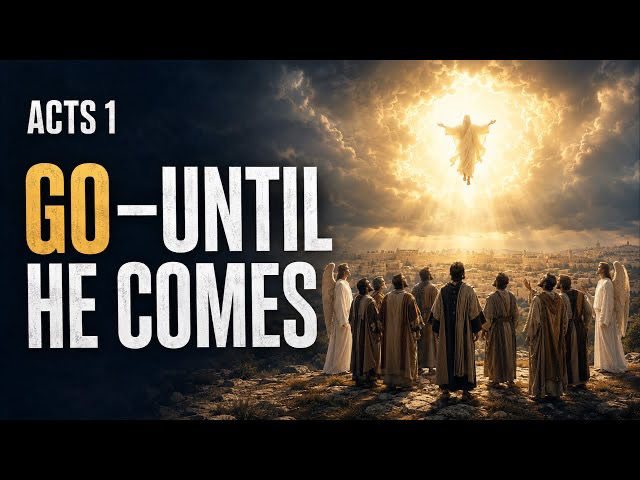
9 Now when He had spoken these things, while they watched, He was taken up, and a cloud received Him out of their sight.
10 And while they looked steadfastly toward heaven as He went up, behold, two men stood by them in white apparel,
11 who also said, “Men of Galilee, why do you stand gazing up into heaven? This [same] Jesus, who was taken up from you into heaven, will so come in like manner as you saw Him go into heaven.”
Notice that it says two men: the author of Hebrews told us that angels can disguise themselves as men.
The angels ask them , “what are you doing? You were told to go back to Jerusalem and wait.”
Jesus is coming back in the same way He left.
Go and do what He’s told you until He returns
12 Then they returned to Jerusalem from the mount called Olivet, which is near Jerusalem, a Sabbath day’s journey. 13 And when they had entered, they went up into the upper room where they were staying: Peter, James, John, and Andrew; Philip and Thomas; Bartholomew and Matthew; James [the son] of Alphaeus and Simon the Zealot; and Judas [the son] of James. 14 These all continued with one accord in prayer and supplication, with the women and Mary the mother of Jesus, and with His brothers.
They obeyed: they returned to Jerusalem as they were told
He names the 11 apostles, some women, the mother of Jesus and His brothers
They all returned in unity, in prayer, in obedience to what they had been commanded.
This is what unity is:
Not compromise
But mutual submission to the commands of Christ.
Message:
Go and do what He’s commanded until He comes
Because He is coming back, just as it was prophesied
Some seasons involve waiting
Others involve active ministry
None of it can be done without being immersed in the Spirit


Comments